
Study Pharmacy in Hungary: University of Debrecen PharmD Guide

Ahsan Naseem
10 min read
4 Comments
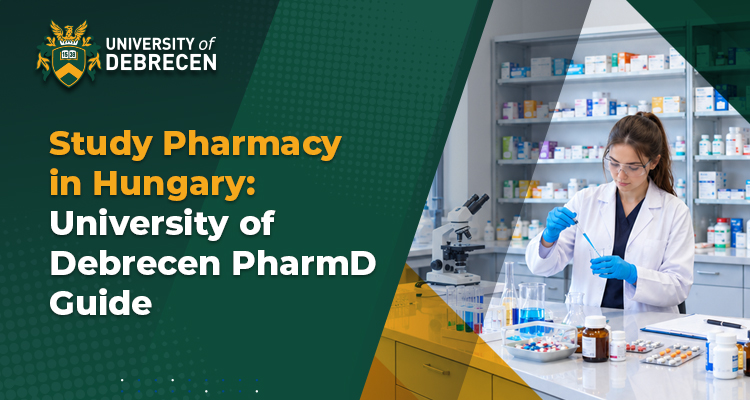
Pharmacy is one of the most practical healthcare degrees you can take. It qualifies you for a profession, it opens doors in both patient care and industry, and at the University of Debrecen it costs less than half what the university's medical and dental programs cost.
This guide covers the Pharmacy PharmD program at the University of Debrecen in full: the qualification, both routes in, the entrance exam, the complete five-year curriculum, the fees, where graduates actually end up, and how to apply.
Pharmacy at the University of Debrecen: Key Facts
| Title | Facts |
|---|---|
| Program | Pharmacy, full-time graduate program |
| Faculty | Faculty of Pharmacy |
| Qualification awarded | 'Pharm.D.', certified as Dr. pharm. (Pharm. D.) |
| Duration | 10 semesters (5 years) |
| Language | English (with Hungarian language courses included) |
| Start date | September |
| Tuition | USD 8,000 per year |
| One-time fees | Application USD 150, entrance procedure USD 350 |
| Entry | High school certificate plus an entrance examination in biology and physics/chemistry (written and oral), or successful completion of the Basic Medicine Course |
| English requirement | Assessed at the compulsory entrance examination |
What Is a PharmD?
PharmD stands for Doctor of Pharmacy. At the University of Debrecen, graduates receive a certificate verifying the awarding of the Doctor of Pharmacy degree, abbreviated as Dr. pharm. (Pharm. D.).
If you're from South Asia, you'll know this qualification as B.Pharm or Pharm-D depending on your country. It's the professional pharmacy degree: the qualification that allows you to work as a pharmacist, subject to registration in the country where you practise.
What the Program Actually Teaches
The program is designed to give graduates the core skills and knowledge required for improving patient health through innovative and collaborative pharmacy practice, medication therapy management, and research.
In practice, the degree covers the chemical, physical, medical, pharmaceutical, pharmacological, and therapeutic properties of medical substances, prescription drugs, and over-the-counter medications, and how these are applied in pharmacy practice, medication therapies, and health care.
That's a wider remit than most students expect. Pharmacy isn't dispensing: it's understanding what a drug does in the body, why it interacts with another drug, how it should be formulated, and how to advise a patient or a doctor accordingly.
Why Study Pharmacy in Hungary?
It's taught in English. The University of Debrecen has offered medical programs in English since 1987.
It costs significantly less than medicine or dentistry. At USD 8,000 a year, pharmacy tuition is less than half the fee for the university's Medicine and Dentistry programs. Among the four Hungarian universities offering pharmacy in English, Debrecen is at the affordable end.
Admission is by entrance exam. You're assessed on your high school record plus the university's own written and oral examination, so you're not competing against a national ranking system.
The curriculum is clinically focused. The Debrecen pharmacy curriculum is known for its emphasis on clinical pharmacy and patient interaction, integrating scientific knowledge with hands-on practice.
The career options are broad. Pharmacy graduates work in community and hospital pharmacies, in industry, in research, and in regulation. That breadth is real protection: if one route doesn't suit you, others remain open with the same degree.
Two Routes Into the Program
Route 1: The entrance examination
You need a
Sample tests are published by the university so you can see the format in advance. The university also runs a Tutoring Seminar for applicants who want to summarise or focus their existing knowledge before sitting the medical entrance exams.
Route 2: The Basic Medicine Course
Applicants can also qualify by successfully completing the Basic Medicine Course at the University of Debrecen. This preparatory course is built for students who don't yet have enough biology, physics and chemistry from high school, and it leads into Medicine, Dentistry and Pharmacy.
- The standard course starts in September and runs two semesters, with tuition of USD 7,500.
- The intensive version, Basic Medicine Course II, runs one semester from January to July.
Students who complete either successfully are directly admitted to their chosen program. If your science marks fall short, or you've been out of school for a while, this is a real route in rather than a closed door.
The Full Five-Year Curriculum
Here's what you actually study, year by year. Note how much chemistry there is early on: pharmacy is a chemistry-heavy degree, and students who dislike chemistry tend to struggle.
Year 1 — chemistry, biology and the language of pharmacy: General Chemistry Theory, General Chemistry Practice, Hungarian Language, Latin Language, Mathematics, Pharmaceutical Biology, Pharmacy Propedeutics, Physics, Biophysics, Inorganic and Qualitative Analytical Chemistry, Organic Chemistry, Pharmaceutical Anatomy, Physical Chemistry.
Year 2 — analytical chemistry and the first pharmacy subjects: Botany, Colloid and Surface Chemistry, Human Physiology, Hungarian Language, Organic Chemistry, Pharmaceutical Biochemistry, Physical Chemistry, Quantitative Analytical Chemistry, Pharmaceutical Technology, Pharmacognosy.
Year 3 — pharmaceutical science proper: Clinical Biochemistry, Medical Hungarian, Pharmaceutical Chemistry, Pharmaceutical Neurobiology, Pharmaceutical Psychology, Pharmaceutical Technology, Pharmacognosy, Immunology.
Year 4 — pharmacology, industry and public health: Medical Microbiology, Pharmaceutical and Bioanalytical Chemistry, Pharmaceutical Bioanalytics and Biotechnology, Pharmaceutical Technology, Pharmacology, Preventive Medicine and Public Health, Bioethics, Clinical Basics, Industrial Pharmaceutical Technology, Pharmaceutical Management and Organization.
Year 5 — clinical practice, patient care and thesis: Biopharmacy, Clinical Pharmacology, Clinical Pharmacy, Drug Interaction Theory, Pharmaceutical Care, Pharmaceutical Communication Skills, Pharmacovigilance, Quality Control, Radiopharmacy, Thesis.
Three things stand out in this structure:
- Pharmaceutical Technology runs across years 2 to 4, with substantial practical hours. Formulation is a craft, and the program treats it that way.
- Year 4 adds Industrial Pharmaceutical Technology and Pharmaceutical Management, which is what makes industry careers realistic rather than theoretical.
- Year 5 is unusually practice-oriented: Clinical Pharmacy, Pharmaceutical Care, Pharmaceutical Communication Skills, Pharmacovigilance and Quality Control. Communication is taught as a subject because advising patients is the job.
Hungarian language appears in the first three years, including Medical Hungarian. You'll need it in a Hungarian pharmacy setting, and it makes life in Debrecen much easier.
The subject list is indicative and may change. Full curriculum and subject requirements are published in the course Bulletin.
Careers: Where a Pharmacy Degree Takes You
The pharmaceutical diploma qualifies graduates to work in:
- Public and hospital pharmacies
- Laboratories
- Pharmaceutical research institutes
- Pharmaceutical companies
- Governmental agencies
- Health maintenance organizations
- Medical service representative roles
What graduates actually did next
The university publishes alumni accounts, and they show the range better than any list:
Tan, from Vietnam, trained in pharmaceutical research at the Faculty of Pharmacy as part of his thesis, and continued as a PhD student at the Medical University of Vienna. He describes the research experience at Debrecen as an essential stepping stone in his academic career.
Erfaneh, from Iran, now works at Viatris as a Qualified Person, a senior regulatory role in pharmaceutical manufacturing, and says she still draws on the knowledge from her studies daily.
Sahand, from Iran, worked as a pharmacist in Hungary after graduating, then as a pharmacy manager in the UK, and later moved into the pharmaceutical industry at Mylan Hungary, becoming supervisor of a quality compliance team of nine people from around the world within six months.
Three graduates, three different paths: academic research, regulatory affairs and industry management. That's the practical argument for pharmacy.
One essential check before you apply: if you plan to practise as a pharmacist in your home country, contact the national pharmacy council or regulator and ask what the registration process is for a graduate of a foreign pharmacy program. Most countries require registration and often an exam for foreign-trained pharmacists. Ask in writing, and ask before you apply.
Fees and Costs
| Fee | Amount |
|---|---|
| Tuition | USD 8,000 per year |
| Tuition across 5 years | USD 40,000 at current rates |
| Application fee (one-time, non-refundable) | USD 150 |
| Entrance procedure fee (one-time, non-refundable) | USD 350 |
| Living costs in Debrecen | About USD 800 per month |
Both one-time fees are paid by bank transfer to start the review of your application.
For the 2026/27 academic year, University of Debrecen tuition includes health insurance, the medical check-up, and the student card. Health insurance is a visa requirement, so that's one less cost and one less thing to arrange.
A realistic total. Five years of tuition at USD 40,000, plus USD 500 in one-time fees, plus living costs of roughly USD 800 a month over about ten months a year, gives a planning figure of around USD 80,000 for the entire degree, excluding flights.
Compare that with the university's six-year Medicine program, where tuition alone is over USD 100,000. Pharmacy is the most affordable of the three medical-faculty programs by a wide margin.
Scholarships and discounts. The university offers academic scholarships and merit-based tuition fee discounts. A merit-based reduction of up to 20% per year is available from the second year of study for students with excellent grade averages, and sibling discounts apply where three siblings study medical and health sciences programs. Depending on your home country's rules, you may also be able to use a federal student loan while studying abroad. The Stipendium Hungaricum government scholarship is another route for students nominated by their home country.
Is Pharmacy Right for You?
Be honest with yourself about three things:
Chemistry. Look again at years one and two: general, inorganic, organic, physical, analytical and colloid chemistry, plus biochemistry. If chemistry was your weakest science at school, this will be a hard five years. If it was your strongest, pharmacy suits you better than most medical degrees.
Precision over drama. Pharmacy rewards accuracy, patience and careful work. Quality control, pharmacovigilance and formulation are detail professions. If you want emergency-room intensity, consider medicine or nursing instead.
People or product. The degree opens both patient-facing roles and laboratory or industry roles. You don't have to choose now, which is one of pharmacy's genuine advantages, but it helps to know which direction attracts you.
How to Apply Through the South Asia Regional Office
Step 1: Free eligibility assessment. Send us your academic transcripts and certificates. We evaluate them and tell you whether you qualify for direct entry to Pharmacy or for the Basic Medicine Course route.
Step 2: Application and fees. Once eligibility is confirmed, pay the application and entrance procedure fees and submit your completed application form with your documents.
Step 3: Entrance exam and interview. The university schedules your written and oral examination in biology and physics/chemistry. We arrange exams within the region, so you don't need to travel to Hungary, and online options are available if you can't attend in person.
Step 4: Letter of Acceptance. Once you successfully qualify, we issue your acceptance letter the very next day so that you can move on to tuition payment, your visa and travel planning.
Documents you'll need: the application form, your high school leaving certificate in English or officially translated, academic transcripts, a passport copy, a short CV, a medical certificate, and bank receipts for your fees.
Pharmacy starts in September. Plan your application with enough time for the entrance exam, acceptance, tuition payment, and your student visa, which together need a couple of months before the semester begins.
Frequently Asked Questions
Can I study pharmacy in Hungary in English?
Yes. The University of Debrecen's Pharmacy program is taught in English. You'll also study Hungarian, including Medical Hungarian, which you need in a Hungarian pharmacy setting.
How long is the pharmacy program?
10 semesters, or five years, leading to the Doctor of Pharmacy (Pharm.D.) qualification.
How much does pharmacy at the University of Debrecen cost?
USD 8,000 per year, plus a one-time application fee of USD 150 and an entrance procedure fee of USD 350. Living costs in Debrecen are around USD 800 a month.
Is pharmacy cheaper than medicine or dentistry?
Yes, substantially. Pharmacy tuition is USD 8,000 a year, compared with USD 16,900 for Medicine and USD 17,500 for Dentistry, and the program is five years rather than six for Medicine.
What is the entrance exam?
A written and oral examination in biology and physics/chemistry. Your English proficiency is assessed at the same compulsory examination. Sample tests are available, and the university runs a Tutoring Seminar for applicants.
What if my science marks aren't high enough?
You can qualify by successfully completing the Basic Medicine Course at the University of Debrecen. The standard course runs two semesters from September at USD 7,500, and an intensive one-semester version runs from January to July.
When does the program start?
September each year.
Do I need IELTS?
English proficiency is assessed at the compulsory entrance examination. An IELTS or TOEFL certificate isn't mandatory at the university, and other evidence of English ability is also accepted.
What jobs can I do with a PharmD from Debrecen?
Community and hospital pharmacies, laboratories, pharmaceutical research institutes, pharmaceutical companies, government agencies, health maintenance organizations, and medical service representative roles. Graduates have also gone on to PhD study and to senior roles in the pharmaceutical industry.
Can I practise as a pharmacist in my home country after graduating?
Most countries require foreign-trained pharmacists to register with the national regulator, often after an examination. Check with that authority before you apply, and we can help you identify who to contact.
Find Out If You Qualify for Pharmacy
Pharmacy is the most affordable of the University of Debrecen's medical-faculty programs, and the entrance route is the same one used for Medicine and Dentistry, so it's worth knowing where you stand before you decide.
Send us your high school results and we'll confirm, free of charge, whether you qualify for direct entry to the PharmD program or for the Basic Medicine Course route, and tell you exactly what to prepare for the entrance exam.
Leave a Reply